
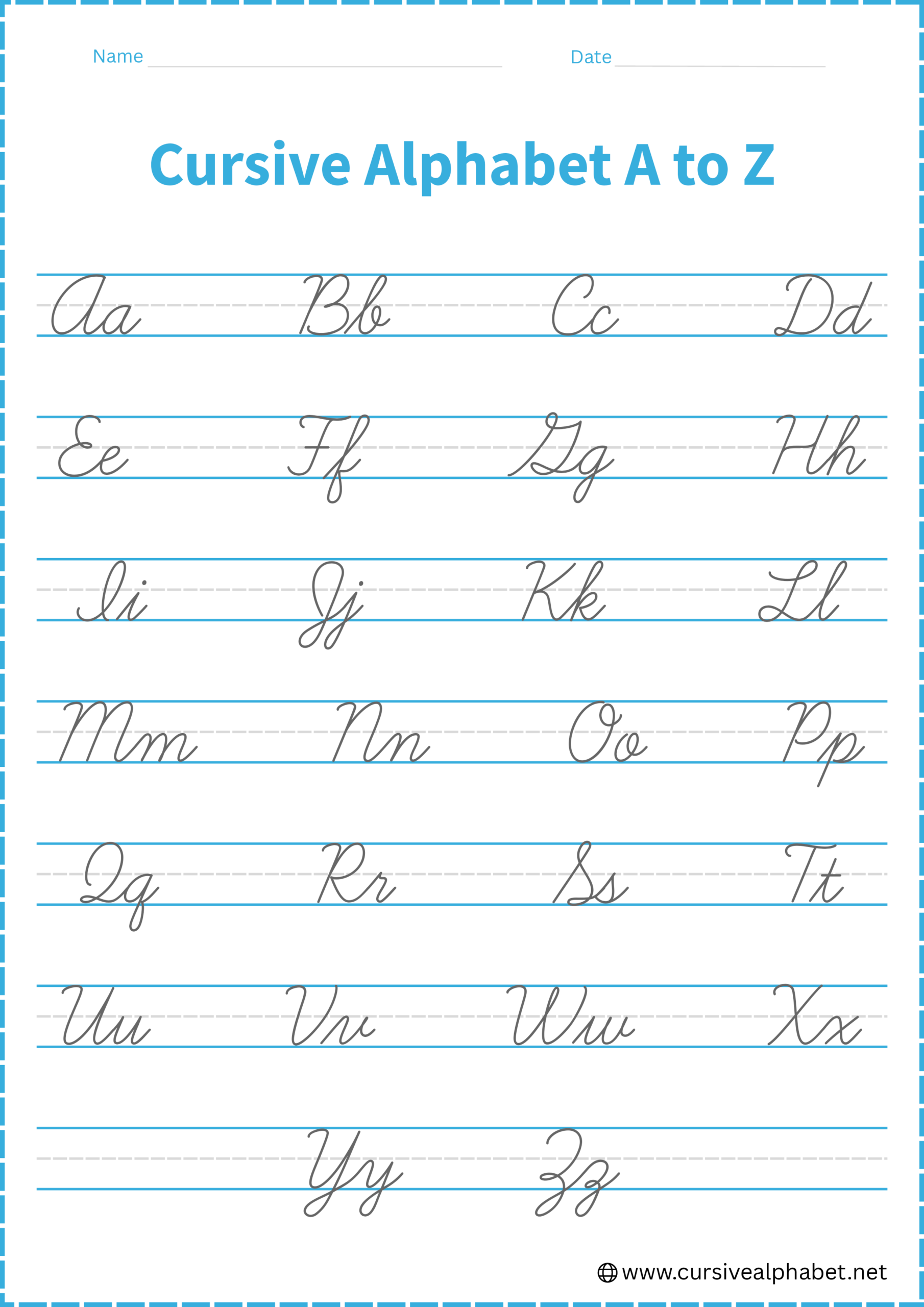
Cursive Alphabet A to Z
Master both uppercase and lowercase cursive letters with our free, printable cursive alphabet A to Z worksheets.
What is Cursive Writing?
Cursive writing is more than just a handwriting style. It encourages creativity, strengthens fine motor skills, and supports better focus and memory development. Whether you are a student, a teacher guiding your classroom, an artist exploring elegant letterforms, or an adult improving your handwriting, this website provides the complete resources and structured cursive worksheets you need to master cursive writing.
How to write letters in cursive?
To master the cursive alphabet, begin with the basics and practice regularly. Focus on correct cursive letter formation, smooth connections, and proper spacing. Practicing in a structured way, you’ll strengthen handwriting, enhance natural letter flow, and build the confidence to write beautifully and fluently in cursive.
Step 1:
Start with Lowercase Cursive Letters
Begin your cursive writing journey with lowercase letters, as they appear most in everyday writing. Focus on correct cursive letter formation, stroke direction, and consistent spacing. Practice similar-shaped letters together, such as ovals (a, c, e, o) and tall letters (l, h, k), to build muscle memory. Writing slowly at first helps create smooth, connected letters, making it easier to form fluent cursive words later.
Step 2:
Master Uppercase Cursive Letters
After mastering lowercase letters, move on to uppercase cursive letters. These larger, decorative letters make your handwriting polished and complete. Focus on proper formation, consistent height, and smooth strokes. Practice loops and flourishes like B, L, and G, and combine uppercase with lowercase letters to create elegant, flowing cursive words.
Step 3:
Practice Cursive Joining Letters
Once you’ve mastered individual letters, focus on connecting letters in cursive. Smoothly link letters without lifting your pen to create natural flow. Start with common pairs like th, ea, and st, keeping spacing consistent and slant even. Gradually progress to full words and short phrases. Regular practice strengthens muscle memory, improves speed, and builds confidence in fluent cursive writing.
Step 4:
Move on Cursive Words
After mastering letter connections, start forming words with cursive letters. Begin with short, simple words to practice smooth joins, consistent slant, and even letter size. Gradually progress to longer words and phrases. Regular word practice strengthens muscle memory, improves speed, and makes your cursive writing look natural and polished.
Step 5:
Write Sentences and Paragraphs in Cursive
Once you’re confident with words, begin writing sentences and paragraphs in cursive. Start with short sentences, focusing on smooth connections, even letter size, and consistent slant. Gradually progress to longer sentences and full paragraphs. Regular practice improves rhythm, strengthens muscle memory, and makes your cursive writing elegant, fluid, and readable.
Common Mistakes to Avoid in Cursive Writing
Even experienced learners can develop bad habits in cursive writing if they’re not careful. Avoiding common mistakes early helps you build clean, fluent handwriting from the start. Watch out for these pitfalls:
- Inconsistent letter size: Letters that are too tall or too short disrupt the flow of words.
- Uneven slant: Tilting letters inconsistently makes writing look messy.
- Broken connections: Lifting the pen too often breaks the natural rhythm of cursive.
- Incorrect loops and strokes: Improperly formed loops on letters like l, e, or f can make letters hard to read.
- Crowded or uneven spacing: Letters or words that are too close together or too far apart reduce readability.
Cursive Writing Tips:
Improving your cursive handwriting takes practice, patience, and attention to detail. Follow these tips to make your writing smooth, consistent, and elegant:
- Practice regularly: Short, daily practice sessions are more effective than occasional long sessions.
- Focus on letter formation: Pay attention to strokes, loops, and proper connections for each letter.
- Maintain consistent slant and size: Keep letters evenly angled and proportionate for neat writing.
- Use proper posture and grip: Sit upright with a relaxed grip to prevent hand fatigue and improve control.
- Start slowly, then build speed: Begin carefully to form letters correctly, then gradually increase writing pace.
- Use worksheets and guided exercises: Structured practice helps reinforce muscle memory and fluency.
- Experiment with styles: Try looped, italic, formal, or casual cursive to find the style that feels natural.
Free Cursive Resources
Download free uppercase and lowercase cursive alphabet A to Z worksheets with clear stroke directions and accurate letter formation. These cursive worksheets help to build a strong foundation for smooth, connected cursive handwriting.
Cursive Joining Letters
Download and practice cursive joining letters worksheets for smooth-flowing words. Focus on entry and exit strokes, consistent slant, and proper spacing to develop natural, effortless cursive connections.
Cursive Words
Practice writing full words in cursive with our free cursive words worksheets. Improve letter connections, handwriting fluency, and build confidence in smooth, flowing cursive writing.
Cursive Sentences
Download & practice writing sentences in cursive to improve letter connections, spacing, and handwriting flow. These worksheets help learners build fluency and write smoothly and confidently.
Cursive Paragraphs
Our cursive paragraph worksheets help to improve flow, spacing, and handwriting confidence. These free printable worksheets are perfect for developing elegant, connected cursive writing.
Frequently Asked Questions
Cursive writing is a style of handwriting where letters are connected for a smooth, flowing effect. It improves fine motor skills, memory, focus, and makes writing faster and more elegant.
Start with lowercase cursive letters, then move to uppercase letters. Practice proper formation, stroke direction, and spacing using cursive alphabet A to Z worksheets for structured learning.
Focus on smooth strokes, consistent slant, and connecting similar-shaped letters. Writing slowly at first helps develop muscle memory and confident lowercase cursive letters.
Practice loops, flourishes, and proper height for uppercase letters. Combine them with lowercase letters in words to create polished, flowing cursive writing.
Avoid inconsistent letter size, uneven slant, broken connections, improper loops, and crowded spacing. Correcting these ensures smooth, legible cursive handwriting.
Practice cursive joining letters without lifting your pen. Start with common pairs like th, ea, and st. Consistent spacing and slant help create flowing cursive words.
Begin with short sentences, focusing on even letter size and smooth connections. Gradually progress to longer sentences to improve rhythm and handwriting fluency.
Yes! Free cursive alphabet worksheets include uppercase, lowercase, words, sentences, and paragraph exercises to help learners practice and improve handwriting.
Absolutely! Adults can learn or refine cursive letters. Structured practice with worksheets or guided exercises helps develop elegant, fluent handwriting at any age.
Regularly practice cursive letters A to Z, connect letters into words, and write sentences and paragraphs. This builds muscle memory and improves speed and consistency.
Cursive letters are connected and flow continuously, while print letters are separate. Learning the cursive alphabet enhances speed, style, and handwriting elegance.